First AI Agent Governance: Owners, Controls and Review Cadence
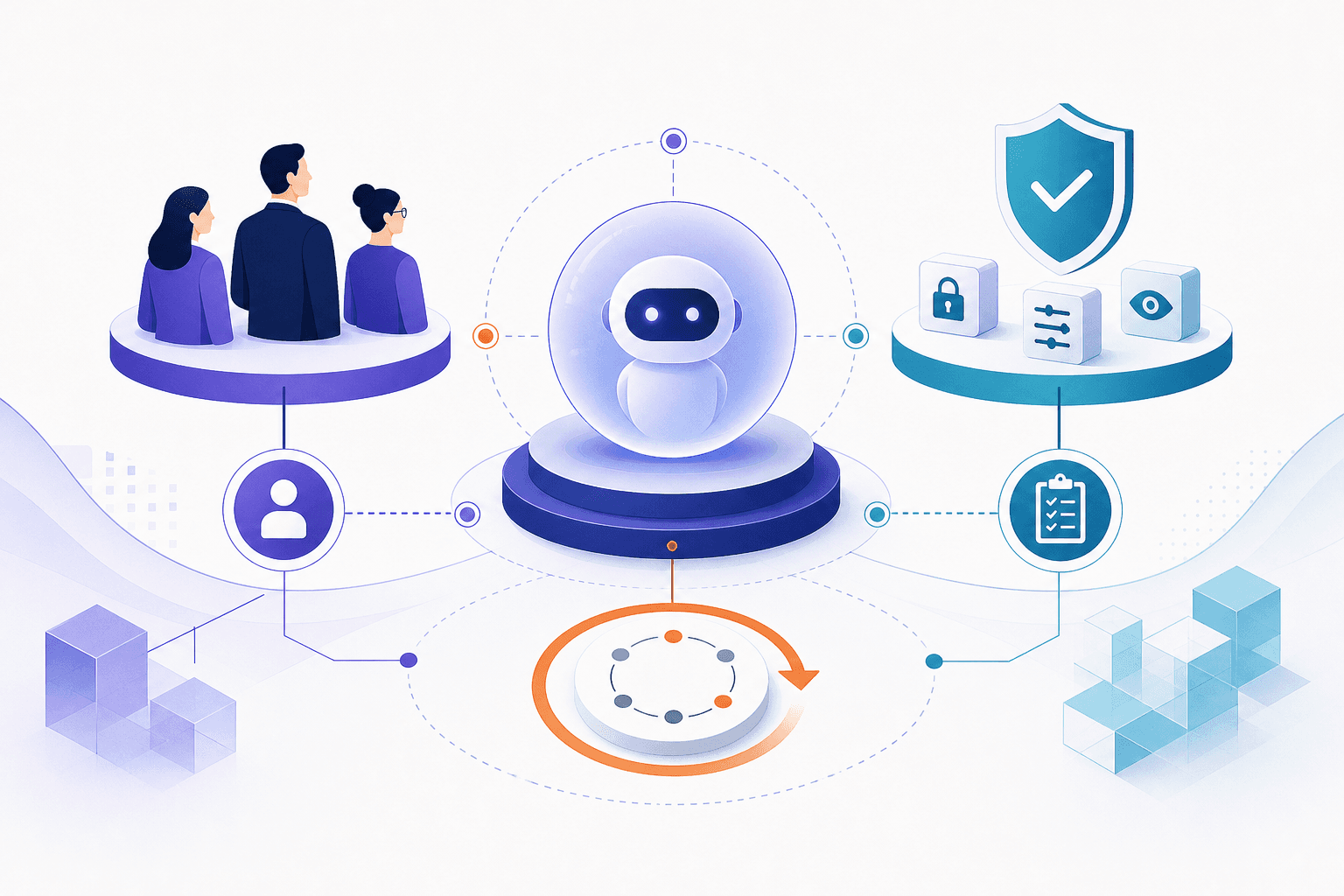
For your first AI agent, use a lightweight governance model built around named decision owners, a versioned operating record, measurable release gates and a regular exception review. An AI agent is software that uses a language model to choose steps and call tools toward a goal. Governance should establish who authorizes that behavior, what limits the software enforces and who takes over when it fails—not merely produce a policy document.
Assign decision rights before assigning tools
A small team does not need a new committee for every agent. It does need explicit responsibilities. Assign these roles to named people, with deputies:
| Role | Decision rights and duties |
|---|---|
| Business owner | Defines eligible work, unacceptable consequences and success criteria; accepts remaining business risk. |
| Technical owner | Implements permissions, tests, monitoring and recovery; controls technical releases. |
| Operating owner | Owns the exception queue, user guidance and manual fallback; can pause the workflow. |
| Data or security reviewer | Reviews sensitive data flows, access boundaries and security-relevant changes. |
One person may hold several roles, but consequential changes should receive a second-person review. A vendor can implement controls; your organization should still name the person accountable for allowing the workflow to operate.
Record who can stop execution immediately and who can authorize restart. Emergency suspension should not depend on convening the people who approved launch.
Keep one operating record per agent
Create a short, versioned record that travels with the deployed configuration. Link supporting tests and implementation details rather than copying them into a large document.
Include:
- Purpose and boundaries: eligible requests, excluded decisions and affected users.
- Authority: available tools, permitted records and fields, approval requirements and prohibited actions.
- Data handling: sources, sensitive fields, recipients, retention and deletion rules, plus provenance and licensing questions for the relevant owners.
- Operating limits: maximum tool calls, elapsed time, spending and workload volume.
- Evidence and recovery: acceptance tests, action history, manual fallback, stop controls and responsible people.
Also record why an agent is necessary. Microsoft’s orchestration guidance recommends matching architectural complexity to the task: a direct model call may suffice, while multiple agents add coordination, delay and failure modes. It also recommends iteration limits for tool-using agents.
The governance implication is straightforward: adding another agent is a scope change, not just an engineering convenience. Ask what additional authority, data sharing and failure handling it introduces.
Translate policy into controls outside the model
A written restriction is not an enforcement mechanism. If the record says an agent cannot change payment details, the connected tool should not expose that operation to it.
Prompt injection means malicious input attempts to redirect a model’s behavior. It can arrive inside ordinary documents or tool results. OWASP’s prevention guidance explains that filtering and prompt formatting do not establish a security boundary; permissions and tool-argument checks must be enforced outside the model.
For each restriction, identify its implementation and test. Read-only access needs read-only credentials. Account isolation needs authorization checks on every request. Consequential actions need approval verified against the exact proposed operation. Logs should capture actions and decisions without accumulating credentials or unnecessary sensitive content.
For implementation detail, see designing least-privilege tool access for AI agents. Least privilege means granting only the access required for the assigned work.
Worked example: govern an internal request-routing agent
Illustrative example: An operations team proposes an agent that reads internal facilities requests, consults an approved service directory and assigns a queue. It cannot authorize expenditure, dispatch contractors or close requests.
The business owner approves queue assignment as the initial scope. The technical owner exposes only directory lookup and assignment tools. The operating owner handles ambiguous requests and maintains the manual intake process.
Before launch, the team sets these illustrative gates:
| Evaluation | Proposed acceptance criterion |
|---|---|
| Routing quality | At least 95% correct assignments across 200 reviewed, representative requests. |
| Mandatory exceptions | Every safety-related or ambiguous case in the test set reaches human review. |
| Access enforcement | Zero successful unauthorized reads or writes in adversarial tests, including injected instructions. |
| Action history | Every attempted assignment records request, destination, policy version and outcome. |
| Operating limits | At least 95% finish within 30 seconds; average model/tool cost stays below $0.05 per request. |
| Recovery | A stop drill blocks new assignments and sends pending work to manual intake. |
These are proposed thresholds, not benchmarks or proof of universal safety. If 192 of 200 routing cases pass, accuracy is 96%; however, one missed mandatory escalation still blocks release. Aggregate quality cannot compensate for a failed critical control.
Review exceptions, changes and restart evidence
If an assignment request times out, its outcome may be unknown. Do not blindly repeat it. Check the destination system first; if the result remains uncertain, hold the request for the operating owner. Preserve enough action history to reconcile it without exposing unnecessary request content.
During the pilot, review exceptions daily. After stabilization, hold a weekly review covering misroutes, blocked actions, unresolved work, cost, response time and reviewer workload. Review access and retention periodically as well.
Require renewed review when tools, permissions, models, source data or workflow scope change. Repeat relevant tests and regression checks—tests that ensure previously working behavior remains intact. Restart after a serious incident only when the cause, affected work and corrective evidence have named sign-off.
AIoverflow builds agents, integrations and the engineering needed to operate them. To turn a proposed agent into an owned, testable workflow, contact AIoverflow.
Sources & further reading
Prepared with AI assistance using the sources above and AIoverflow’s service context. Examples are illustrative; validate implementation decisions against your own requirements. Suggest a correction.