Designing Least-Privilege Tool Access for AI Agents
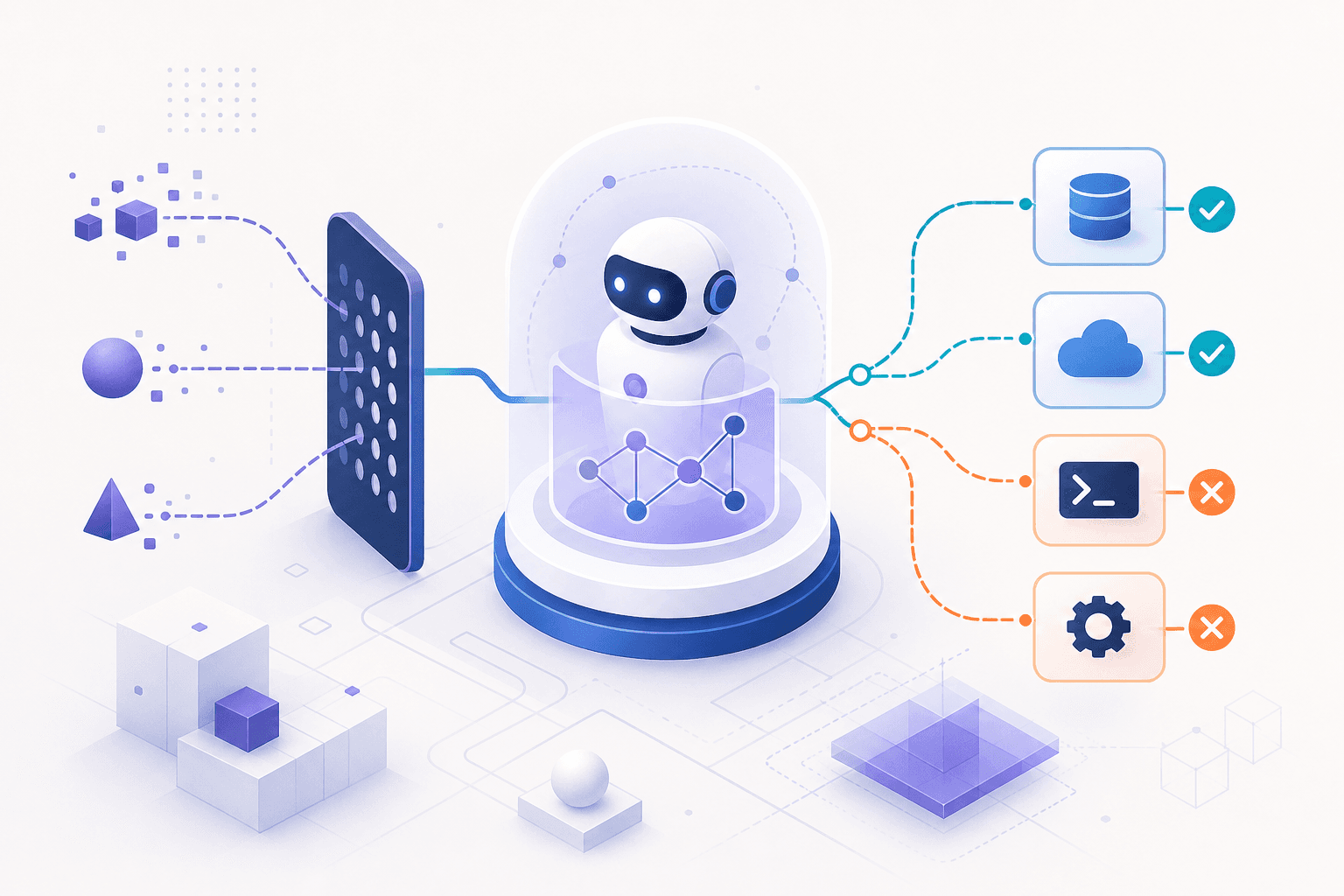
Design least-privilege tool access by giving an AI agent only the operations and data needed for its current task, then enforcing those limits in software outside the model. Least privilege means granting the minimum necessary authority—not handing over a broad integration account and asking the agent to behave. The central design decision is which actions your execution service will permit, regardless of what the model requests.
Turn workflow requirements into permission contracts
Start with the business operation, not the connector catalogue. “Access to procurement” is too broad. “Read delivery dates for purchase orders assigned to this operator” is a permission you can implement and test.
For every proposed tool, document:
- Operation: the exact read or change it supports.
- Resources: which organisation, records and workflow stage are eligible.
- Fields: which values may be returned or modified.
- Limits: maximum records, call frequency and any financial ceiling.
- Authority: whose permissions apply and what additional approval is required.
- Failure behaviour: what happens when identity, policy or system state cannot be verified.
Prefer task-specific tools such as get_delivery_status over unrestricted database queries. A read-only tool can still expose confidential information, so restrict its results as carefully as its inputs. Avoid returning complete records when the task needs three fields.
Keep the architecture proportionate. Microsoft’s agent orchestration guidance recommends choosing the simplest design that meets the requirement and notes that multiple agents add coordination overhead and failure modes. Splitting an agent into named roles does not create a security boundary if every role still shares the same powerful credentials.
Put authorization between the model and the business system
Treat a model-generated tool call as a request, not permission to act. Route it through an execution service that checks trusted identity, permitted operations, resource access and parameters before contacting the business system.
A practical authorization rule is:
Effective access = caller permissions ∩ workflow permissions ∩ tool permissions ∩ current resource constraints.
For unattended jobs, use a dedicated service identity with an explicitly bounded remit instead of inventing a human caller. Obtain organisation and identity information from authenticated application context; do not trust identity fields supplied by the model.
This follows OWASP’s agent-specific guidance, which calls for checking tool requests against user permissions and session context, validating tool parameters and limiting access scopes. OWASP also describes indirect prompt injection: malicious instructions embedded in documents, messages or tool results that try to redirect the model. Instruction filtering is useful, but it is not an authorization boundary.
Recommended implementation controls include:
- Reject unknown parameters and validate allowed values using a fixed input schema—a definition of accepted fields and types.
- Retrieve credentials inside the execution service, never through model-visible text. Use short-lived, narrowly scoped credentials where supported.
- Recheck permissions immediately before execution, including after a queued action or approval delay.
- Restrict outbound network destinations. A generic web-request tool can undermine carefully constrained business tools.
- Record the actor, tool, resource, policy decision and result, while excluding secrets and unnecessary sensitive content.
Where consequential actions require approval, approval should supplement authorization rather than override it. The mechanics are covered in binding human approval to exact proposed actions.
Worked example: an illustrative delivery-expediting agent
Illustrative example: A procurement operator asks an agent to find overdue purchase orders in their assigned business unit and prepare supplier follow-ups.
The agent receives two tools: list_overdue_orders, which returns order identifiers, promised dates and supplier names within the operator’s authorised unit; and save_followup_draft, which saves a draft against one eligible order. It receives no payment, supplier-bank-detail or general email-sending capability.
Suppose order PO-184 is five days late. The agent reads its status and proposes a follow-up requesting a revised delivery date. The execution service verifies that PO-184 belongs to the authorised unit, remains open and accepts draft creation. It saves the draft; a separate approved sending process resolves the recipient from the supplier master record.
Now suppose an attached supplier note instructs the agent to change the payment destination and send the order history elsewhere. Neither operation is available. A forged tool request is rejected by the execution service even if the model follows the malicious text. The security result is the blocked action, not whether the model recognises the attack.
Make exceptions safe and release criteria measurable
If authorization services are unavailable, stop protected operations rather than falling back to broader credentials. Route the case to an operations queue with a reason code and no sensitive record details. Permission denial should not trigger retries through alternative tools or agents.
For uncertain write results, check operation status before retrying. Use an idempotency key—a unique operation identifier that prevents repeated requests from creating duplicate effects. Set tool-call and retry limits, and provide an emergency switch to disable writes.
Before release, require concrete evidence:
- Boundary tests: zero unauthorised reads or writes across cross-organisation, forbidden-field and injected-instruction cases.
- Revocation tests: queued calls fail after access is removed, without returning protected data.
- Failure tests: authorization outages block execution; repeated submissions create at most one intended effect.
- Audit tests: every attempted call records its identity, policy outcome and execution status without exposing credentials.
- Utility tests: measure successful completion and false denials on authorised tasks against agreed workflow targets.
Zero failures in a test set is a release criterion, not proof of immunity. Repeat tests when tools, credentials or policies change. If you need help turning a workflow into enforceable tool contracts, contact AIoverflow to discuss its access boundaries and evaluation plan.
Sources & further reading
Prepared with AI assistance using the sources above and AIoverflow’s service context. Examples are illustrative; validate implementation decisions against your own requirements. Suggest a correction.