When Regulated Teams Should Run a Local Language Model
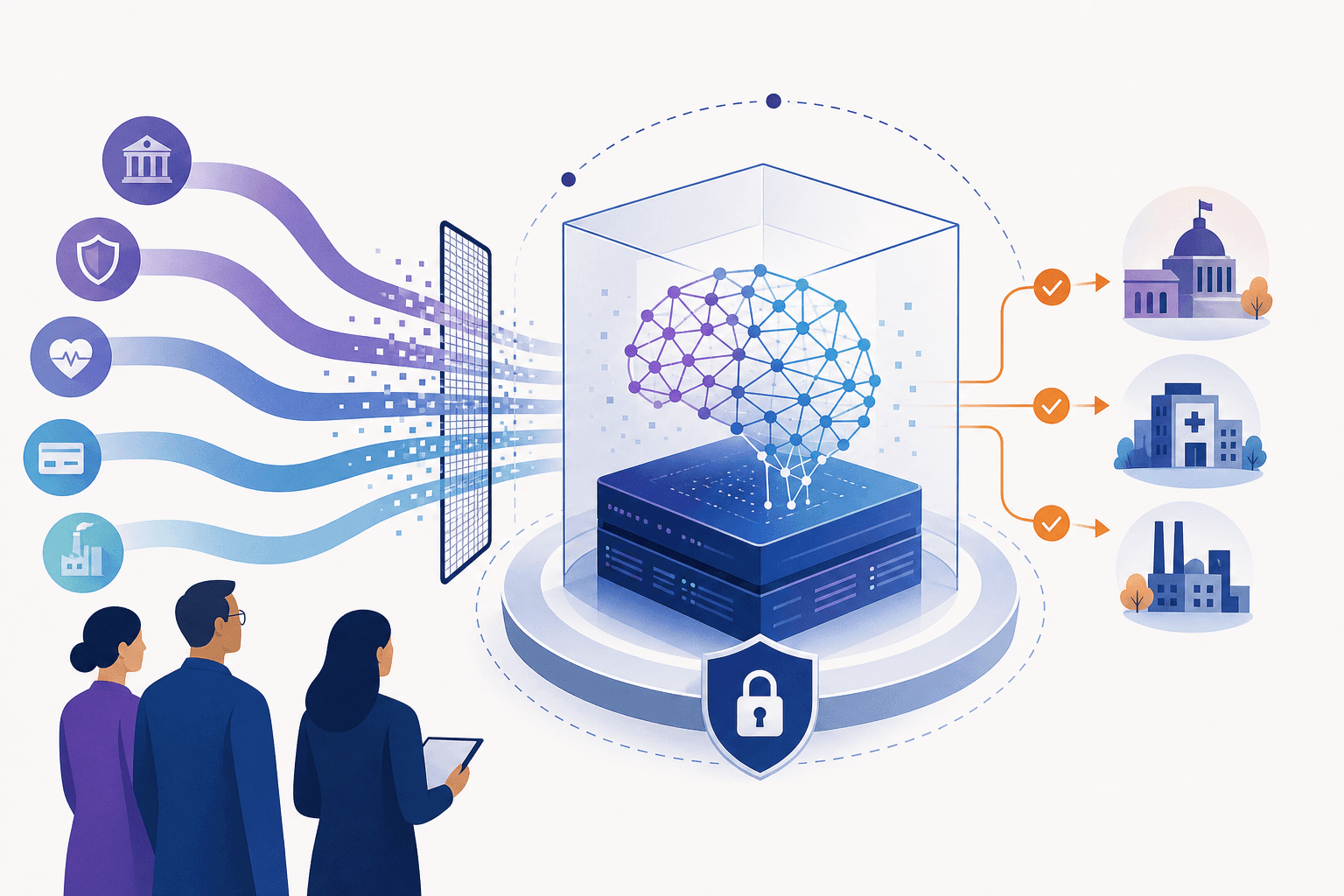
A local language model is the right choice for a regulated team when sensitive information must stay within infrastructure the team controls, the model meets a bounded workflow’s quality requirements, and someone can operate it reliably. It is not automatically the right choice simply because the organisation is regulated. For an internal policy assistant, for example, local deployment makes sense only if the complete document-to-answer workflow respects the required boundary—not just the model generating the answer.
Start with the constraint that requires local execution
Here, local means the model runs on organisation-controlled devices or on-premises servers rather than an external model service. A privately hosted cloud model is another option, but it is not the same deployment arrangement.
Before choosing hardware, write down the restriction local execution is supposed to satisfy. Useful statements include:
- Case documents cannot be transmitted to an external processing service.
- The workflow must continue during loss of internet connectivity.
- Model changes must go through an internal release approval process.
- Administrators must control where processing records and backups reside.
Have the relevant legal, security and compliance owners validate those requirements. A preference for “private AI” is too vague to guide architecture.
Local deployment changes who controls processing; it does not establish lawful use, appropriate access or answer accuracy. If an approved managed service satisfies the actual requirements, compare it rather than excluding it by assumption. If no team owns patching, capacity, recovery and model updates, local hosting may introduce responsibilities the organisation cannot yet support.
Draw the boundary around the whole workflow
For a policy assistant, the model is only one component. Documents may pass through text extraction, indexing, search, prompt assembly and monitoring before anyone sees an answer.
Retrieval-augmented generation (RAG) supplies a language model with relevant material retrieved from a document collection. Microsoft’s RAG design guidance describes both the document-processing pipeline and the search-to-answer flow. That distinction matters: running generation locally does not keep data local if document extraction or search still calls an external service.
Create a data-flow inventory covering:
- Original files, extracted text and search indexes.
- Embeddings—numerical representations used for similarity search.
- User questions, retrieved passages and generated answers.
- Diagnostic logs, crash reports, backups and administrator access.
For each, record its location, permitted users, retention rule and network destinations. Recommend denying outbound network access by default where the boundary requires it, then explicitly approving necessary exceptions. Separate model-download and software-update procedures from routine processing.
Document access must also survive retrieval: employees should not receive restricted passages merely because those passages share an index with public policies. Local hosting is no substitute for permission checks.
Size the model without confusing fit with readiness
Quantization stores model parameters at lower numerical precision to reduce memory requirements. The Hugging Face quantization overview explains that methods differ in hardware support and calibration requirements while aiming to preserve accuracy.
Treat quantization as a configuration to test, not a free optimisation. A model that loads successfully has not demonstrated that it can serve several users, process long policies or preserve important exceptions.
Measure the exact model, quantization method, runtime and hardware combination intended for deployment. Include memory needed during active requests, not just stored parameters. Compare total operating cost against acceptable alternatives: hardware, maintenance, security work, recovery capacity and human review all belong in the calculation.
For this workflow, a fixed search-and-answer sequence is a sensible starting recommendation. It is easier to bound than a system that independently selects tools or takes actions.
Worked example: an internal policy assistant
Illustrative example—not a client deployment: a regulated insurer wants claims staff to ask questions about internal handling procedures. Case information must remain on-premises, and the assistant must not make coverage decisions.
An employee asks: “The customer supplied an incomplete evidence package. What should I request next?”
The application verifies the employee’s access, searches approved procedure documents and supplies relevant passages to the local model. The response presents a draft checklist with document version and section citations. The employee checks the checklist before contacting the customer. The assistant cannot send messages or change the claim record.
If two applicable procedures conflict, the application should withhold a definitive recommendation and route the question, retrieved passages and conflict reason to the policy owner. If search returns no adequate evidence, it should say the answer cannot be established from approved material. Model failure should return users to manual policy search—not silently forward their question to a public model.
Set release gates before purchasing capacity
Microsoft’s guidance recommends evaluating individual RAG stages and the final response, including representative questions and questions the collection cannot answer. Apply that approach with explicit release gates.
For the illustrative assistant, candidate criteria could be:
- Evidence quality: reviewers judge at least 95% of answerable test responses correct and supported by cited passages, with no critical procedural errors.
- Exceptions: every designated conflicting-policy or missing-evidence test triggers the required escalation or abstention.
- Isolation: no prohibited outbound traffic or cross-role document disclosure occurs in the security test suite. Passing tests is evidence, not proof of universal security.
- Capacity: 95% of requests finish within an agreed limit under expected simultaneous use.
- Recovery: a simulated server outage restores manual access and demonstrates the documented rollback procedure.
Assign owners to failures and rerun tests after model, index or runtime changes. Approve local deployment only when its control benefits survive these operational checks.
AIoverflow’s private AI and model deployment service evaluates local, cloud and hybrid options against real workflows. If you need to turn a data-boundary requirement into a testable deployment decision, contact AIoverflow.
Sources & further reading
Prepared with AI assistance using the sources above and AIoverflow’s service context. Examples are illustrative; validate implementation decisions against your own requirements. Suggest a correction.