Move an AI Pilot to Production Without a Full Rebuild
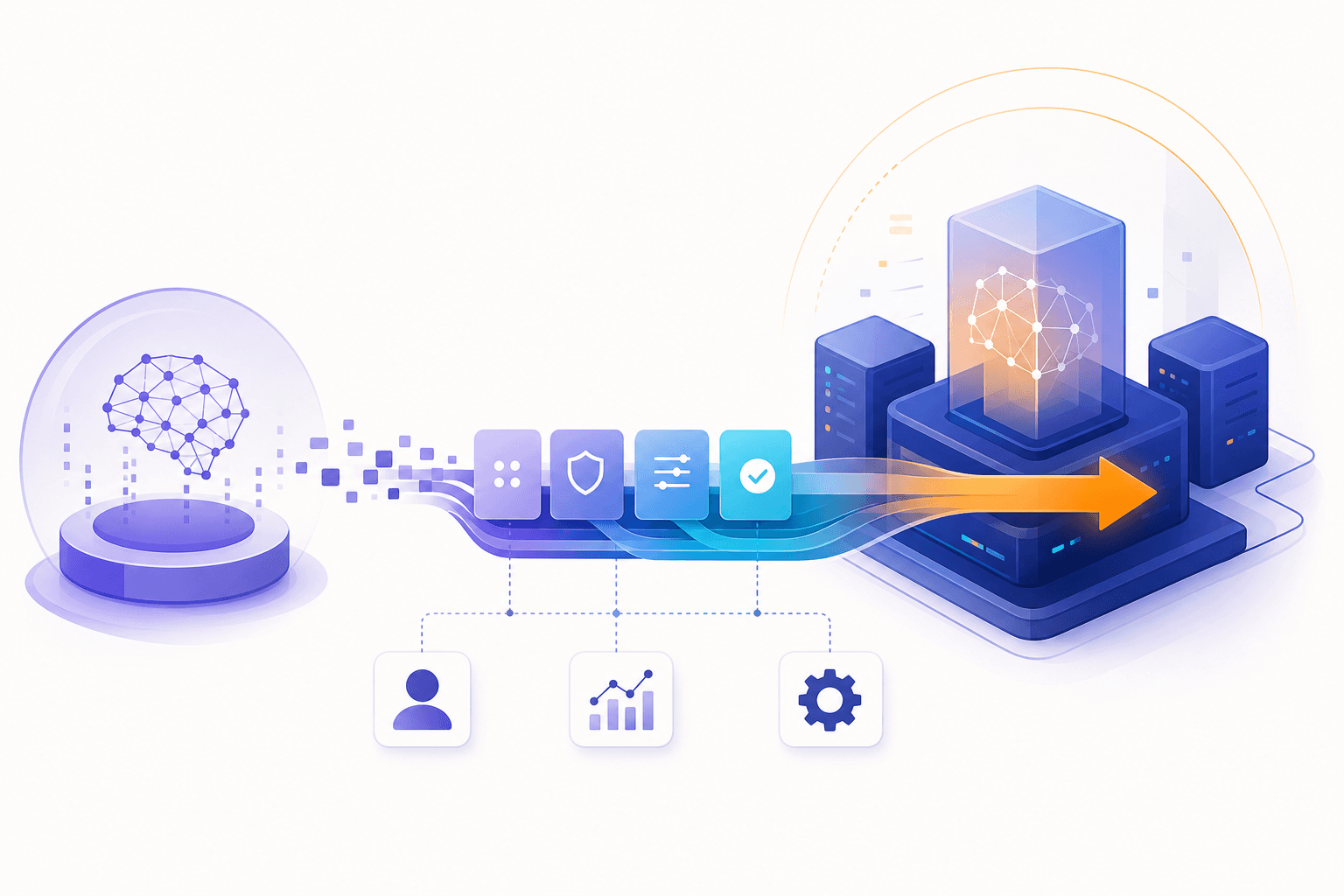
Move an AI pilot into production by keeping its proven task logic and replacing the surrounding shortcuts—not by automatically changing models, frameworks or architecture. Put the AI step behind a stable interface, move permissions and execution into application code, and shift traffic incrementally. A targeted rebuild is justified where the pilot cannot isolate customer data, recover interrupted work or prevent unauthorized actions; otherwise, strengthen the existing system one boundary at a time.
Decide what to keep, wrap and replace
Start with an inventory of the pilot’s actual request path. Follow one input through data access, model calls, validation and any business-system updates. Record hidden dependencies such as a developer’s credentials, local files or manual cleanup.
Classify each component:
- Keep: prompts, parsing logic, reviewed examples and business rules that pass representative tests.
- Wrap: model calls and integrations that work but need explicit inputs, validated outputs, timeouts and version tracking.
- Replace: shared credentials, in-memory-only job state, unrestricted writes and dependencies on a developer’s laptop.
Preservation should depend on evidence, not sunk cost. A successful demonstration is not enough to retain a component unchanged.
Nor does production automatically require multiple AI agents—systems that choose and invoke tools. Microsoft’s orchestration guidance distinguishes direct model calls, single agents and coordinated agents, noting the extra coordination, latency and cost of greater complexity. For a bounded classification task, a direct call inside ordinary application code may remain appropriate.
Create a stable boundary around the AI step
Define a contract: the exact inputs, outputs and error states the rest of the application can expect. For example, accept a request identifier and authorized text; return a category, supporting evidence and a status such as ready_for_review or unable_to_process.
Validate that contract in code. A correctly formatted category can still be wrong, so separate structural validation from checks of meaning and business policy.
Keep the model-specific integration behind a small adapter—a component that translates your application’s contract into a provider’s request format. Avoid building a universal abstraction for hypothetical future providers. The immediate goal is to change a model or prompt without changing every caller.
Version the prompt, model configuration and output contract together. Record which versions processed each job. Persist progress before consequential actions, and make repeated submissions safe through idempotency: processing the same operation again must not create another business effect.
These are recommended engineering boundaries, not features a new agent framework will necessarily supply for you.
Worked example: migrate a service-request classifier
Illustrative example: an internal facilities team has a pilot that reads maintenance requests and suggests a category and urgency. It runs as a script, uses one model call and writes suggestions into a spreadsheet.
The production destination is the existing work-order system—not a new AI platform.
- Preserve the classifier. Package its prompt and parsing function as a callable component. Save its current results on reviewed requests as the comparison baseline.
- Replace intake. Accept requests from the work-order system with a stable request identifier and the user’s authorized building scope.
- Add a proposal record. Store the suggested category, urgency, evidence and classifier version separately from the official work order.
- Retain staff control. Staff accept or correct suggestions in their existing workflow. Application code, not the model, performs the update.
- Move traffic gradually. First run in shadow mode, meaning suggestions are recorded but do not affect staff decisions. Then enable visible suggestions for one building before expanding.
For a request saying “water dripping near the electrical panel,” the classifier might propose plumbing with urgent review. Staff can instead route it to the safety team. Preserve that correction as evaluation evidence rather than silently rewriting the original proposal.
Exception path: if the model times out or returns an unsupported category, leave the original request intact and send it to manual triage. If an update times out after submission, check the recorded operation identifier and destination state before retrying. An uncertain write must not become a duplicate work order.
Secure the boundary, not just the prompt
Moving from curated examples to live text introduces prompt injection: instructions embedded in input that attempt to redirect model behavior. OWASP’s prevention guidance covers indirect attacks through external content and recommends layered controls, including permission checks, output validation and restricted tool access.
For the facilities example, request text is data, not authority to change building permissions or close another person’s work order. Separate instructions from input, but do not treat that separation as a security guarantee. Enforce authorization in application code and give the classifier no write credentials. Minimize sensitive text in logs and restrict access to retained records.
Set release gates and rehearse reversal
Agree on acceptance criteria before enabling production traffic. Illustrative gates for this workflow could include:
- At least 95% category agreement on 300 independently reviewed requests, with results broken down by category.
- No missed urgent cases in a separately maintained safety test set; this is a release gate, not proof of zero future misses.
- No unauthorized writes or duplicate effects in permission, retry and interruption tests.
- A 95th-percentile response time below five seconds, meaning 95% of tested requests finish within that limit.
- Combined inference and review cost per request below an agreed budget, with manual-triage volume within staffing capacity.
Use a representative evaluation set, not just the pilot’s easiest examples. Assign an operational owner and test the switch that disables AI suggestions while preserving normal intake. Reverting code cannot undo completed writes; record those separately for reconciliation.
If you need help identifying what to preserve and what to replace, contact AIoverflow to discuss a bounded production migration.
Sources & further reading
Prepared with AI assistance using the sources above and AIoverflow’s service context. Examples are illustrative; validate implementation decisions against your own requirements. Suggest a correction.