Model Routing That Balances Privacy, Quality, Speed and Cost
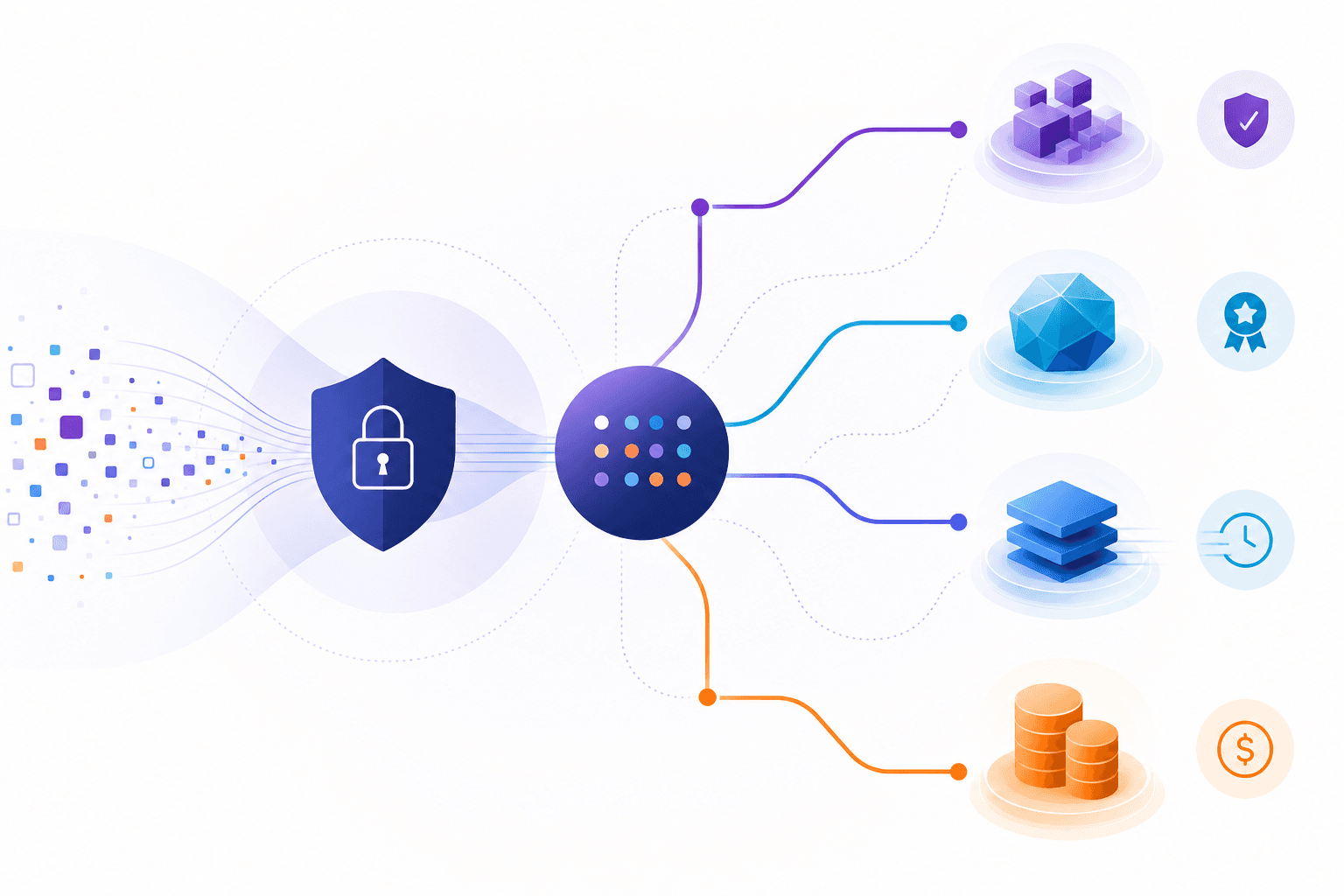
Use model routing—the selection of a model endpoint for each request—to optimize speed and cost only after enforcing privacy restrictions and minimum quality requirements. For an internal knowledge assistant, this means defining permitted destinations, assigning routine and complex questions to tested routes, and providing a bounded exception path. The router should implement an explicit business policy, not simply send easy-looking prompts to the cheapest model.
Separate eligibility from optimization
Start with a route registry: a versioned list of available endpoints and their operating constraints. For each endpoint, record permitted data classes, hosting location, retention requirements, supported input types, input-size limits, measured quality, response time and cost.
Apply routing decisions in this order:
- Eligibility: Can this endpoint receive the complete request, including retrieved documents and conversation history?
- Capability: Does it support the required language, input length and output format?
- Quality: Has it passed reviewed tests for this task category?
- Optimization: Among eligible routes, which meets the response deadline at the lowest expected workflow cost?
Treat uncertain data classification conservatively. Do not send sensitive text to an external classification model just to decide whether external processing is allowed. Use trusted document labels, access controls and an approved classification process. Recheck eligibility after assembling the final input: an ordinary question may retrieve confidential material.
Keep these rules outside user-controlled prompts. A request to use a different provider must not override the destination policy. Apply the same restrictions to logging, caches and monitoring services.
Route by evidence and task, not model confidence alone
For a knowledge assistant, retrieval-augmented generation, or RAG, supplies retrieved source material to the model before it answers. Microsoft’s RAG design and evaluation guide distinguishes retrieval evaluation from answer evaluation and recommends representative queries, including questions the documents cannot answer.
That distinction matters for routing. A more capable model might reconcile several policy passages, but switching models cannot supply a policy missing from the retrieved material.
Begin with inspectable rules based on task type, evidence availability, document labels and input length. For example, route a single-policy lookup differently from a comparison across several policies. Use a model-based router only if testing shows it improves decisions enough to justify its own processing cost, delay and privacy exposure. A model’s self-reported confidence is not an acceptance test.
A local route may use quantization, which reduces the numerical precision used to store model parameters and sometimes intermediate values. The Hugging Face quantization overview explains that methods trade memory requirements against speed and accuracy. Treat the quantized configuration as a separate candidate to evaluate; lower memory use does not establish faster responses or sufficient quality on your hardware.
Worked example: an internal policy assistant
Illustrative example—not an AIoverflow deployment: a company offers employees answers about travel and purchasing policies. It defines three routes:
| Request condition | Route | Acceptance check |
|---|---|---|
| Routine lookup with sufficient evidence | Economical approved model | Answer matches the cited policy |
| Multi-policy comparison with externally permitted data | Higher-capability approved endpoint | All relevant conditions are covered |
| Restricted documents or employee details | Private endpoint only | Same quality checks; no external fallback |
Suppose 1,000 externally permitted requests include 800 routine lookups and 200 complex comparisons. Assume generation costs of $0.002 per economical call and $0.02 per higher-capability call. If 10% of routine requests require one higher-capability retry, generation cost is:
800 × $0.002 + (200 + 80) × $0.02 = $7.20.
Sending all 1,000 directly to the higher-capability endpoint would cost $20 under those assumptions. These are illustrative inputs, not provider prices or projected savings. Routing, retrieval, validation, infrastructure and human review remain additional costs.
The 80 retried requests also incur both calls’ elapsed time. Set a maximum end-to-end duration and allow at most one escalation. Route known complex tasks directly rather than requiring every request to fail on the economical model first.
Make exceptions preserve the original boundary
Distinguish three failures. If evidence is missing, return a clarification request or refer the question to the policy owner. If evidence is sufficient but the answer fails validation, try one eligible alternative within the remaining budget. If the private endpoint is unavailable, queue the request or offer manual handling—never silently use an unapproved external endpoint.
Record the route, policy version, reason, validation result and fallback outcome without unnecessarily retaining sensitive content. Assign queued cases an owner and deadline; this is where accountable escalation paths complement model selection.
Evaluate the routing policy before release
Compare routed execution with a fixed, eligible baseline on the same reviewed test set. Include restricted inputs, unavailable endpoints, unsupported questions and peak-load conditions. Suggested illustrative release gates are:
- Privacy: Zero prohibited destination calls in boundary and outage tests.
- Quality: At least 95% acceptable answers in each supported task category, with no critical policy misstatements.
- Speed: Routine requests finish within four seconds at the 95th percentile, meaning 95% finish within that limit; measure escalated requests separately.
- Cost: Track total operating cost per accepted answer, including failed calls and review effort.
- Recovery: Every exhausted route produces an explicit unresolved state and an owned next step.
Version routing rules alongside model configurations. Release changes gradually and retain a rollback option. AIoverflow connects workflow discovery, integrations, evaluation and deployment; contact us to scope a routing policy around your data boundaries and operating requirements.
Sources & further reading
Prepared with AI assistance using the sources above and AIoverflow’s service context. Examples are illustrative; validate implementation decisions against your own requirements. Suggest a correction.