Measure AI Automation Quality by Verified Business Outcomes
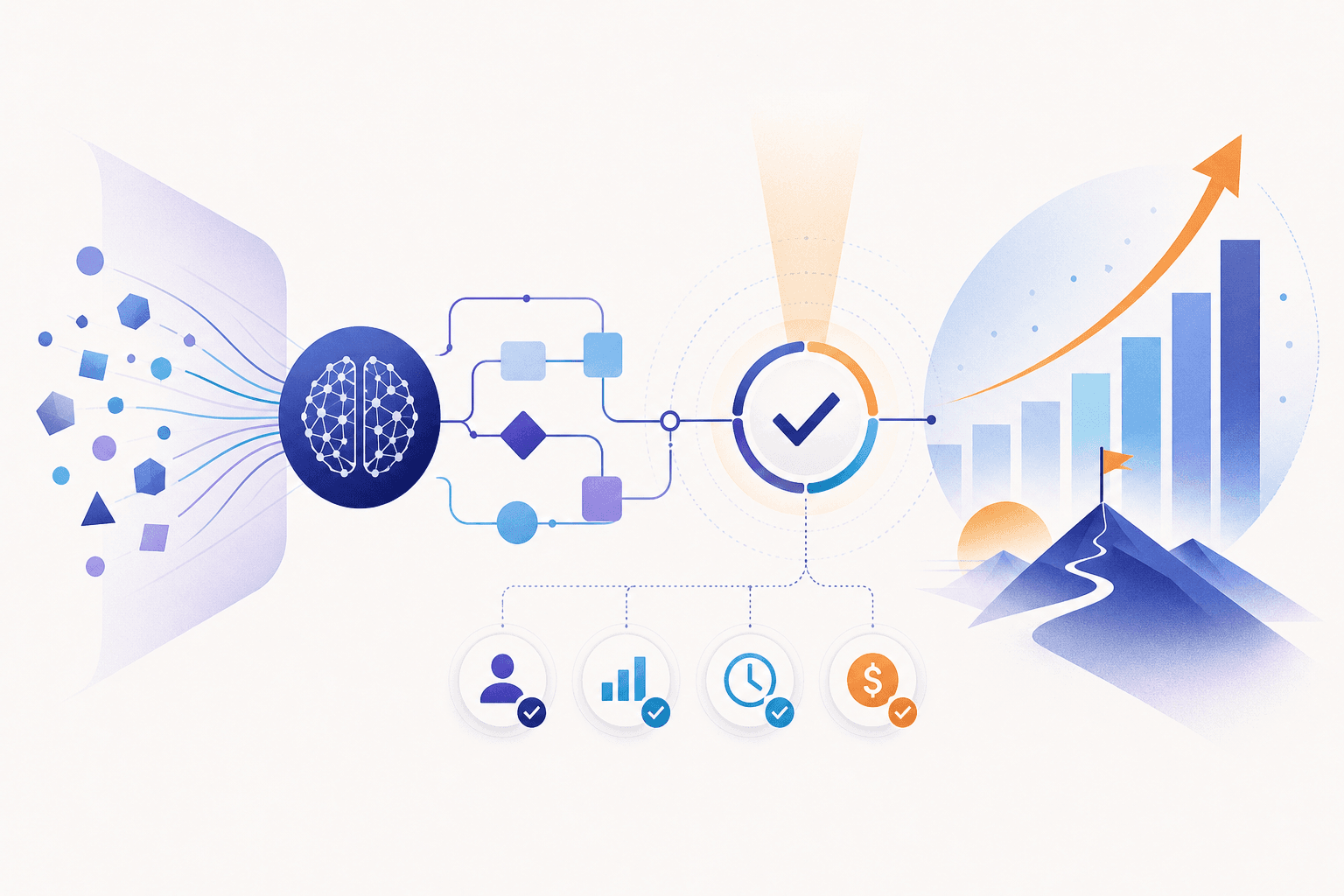
Measure AI automation quality by checking whether eligible work reaches a correct, authorized business outcome—and what it costs to get there. Counts of processed documents, generated answers or automated actions show activity, not value. For an invoice-to-accounting workflow, the useful question is not how many invoices AI touched, but how many became correct records without avoidable correction, delay or unauthorized changes.
Define completion before building the dashboard
Start with a measurement contract: a short agreement specifying eligible work, success conditions, observation period and accountable owner. This prevents teams from changing the denominator—the population used to calculate a rate—when difficult cases appear.
For invoice processing, eligibility might mean invoices from approved suppliers in supported currencies. A successful outcome could require the correct supplier, amount, currency and purchase-order reference, recorded once in the accounting system with required approval.
Count each business item once, even if it triggers several model calls or retries. Keep rejected, escalated and unresolved eligible items visible. Report excluded work separately, including why it was excluded; otherwise narrowing eligibility can masquerade as improving quality.
Choose an observation window long enough to discover downstream corrections. A record that looks correct at insertion may be disputed during reconciliation. Until that window closes, label results provisional rather than verified.
Use a balanced scorecard, not one headline percentage
A practical scorecard should distinguish quality, coverage, effort and safety:
| Measure | Suggested definition | Decision it supports |
|---|---|---|
| Verified straight-through yield | Correct items completed without human intervention ÷ all eligible items | Whether automation genuinely covers the workload |
| Autonomous completion quality | Correct autonomous completions ÷ all autonomous completions | Whether the automatic path is reliable |
| Human effort per eligible item | Review, correction and exception minutes ÷ eligible items | Whether work is reduced or displaced |
| Cost per verified outcome | Total workflow operating cost ÷ verified completed items | Whether the workflow is economical |
| End-to-end completion time | Intake to confirmed completion, including queue time | Whether service improves |
| Critical failures | Counts by severity, with exposure denominators | Whether automation must be paused |
Report median completion time alongside the 95th percentile—the time within which 95% of completed items finish—and show unresolved backlog age separately. Otherwise, stalled items disappear from timing statistics.
Model calls, retries and agent handoffs remain useful diagnostic measures. They are not success measures. Microsoft’s orchestration guidance explains that added agent complexity brings coordination overhead, delay and cost. Require an additional review agent to demonstrate better verified outcomes, rather than treating more reasoning steps as inherently valuable.
Worked example: a completion rate hides correction work
Illustrative example—not an AIoverflow deployment: A pilot receives 1,000 eligible invoices. Its dashboard reports 700 completed automatically, suggesting a 70% automation rate.
After the agreed reconciliation window, reviewers establish that:
- 665 automatic completions were correct.
- 35 automatic completions needed correction.
- 250 invoices were escalated and subsequently completed correctly.
- 50 remained unresolved.
Verified straight-through yield is therefore 665 ÷ 1,000 = 66.5%. Autonomous completion quality is 665 ÷ 700 = 95%. After corrections and escalations, 950 items have verified outcomes, but that does not make the workflow 95% autonomous.
Assume the pilot incurred $300 in model and infrastructure costs and 40 hours of review, correction, exception handling and allocated operating effort at $30 per hour. Total operating cost is $1,500, or $1.58 per verified outcome. The remaining 50 items still carry future work and cost; update the calculation when they resolve.
If a comparable manual workload required 70 hours, the observed reduction is 30 labor hours—not the 49 hours implied by applying 70% automation to the baseline. Compare equivalent workloads and completion states before claiming savings. Report implementation costs separately when assessing overall payback.
Verify the measurements and test unsafe success
Use accounting-system evidence and independent review, not the model’s declaration that it finished. Review a random sample of automatic completions and all known serious incidents. Break results down by supplier, document format and other relevant categories. If difficult cases are deliberately oversampled, weight estimates back to the actual workload mix.
For the supporting review process, see building an evaluation set from real business work. Keep sample sizes visible: zero observed failures in a small sample does not establish zero risk.
Test whether apparently successful actions were authorized. Prompt injection means malicious instructions embedded in input attempt to redirect model behavior. OWASP’s guidance recommends enforcing permissions and validating tool arguments outside the model, while measuring false positives on legitimate inputs. Accordingly, track both unauthorized actions that execute and legitimate invoices unnecessarily blocked by security checks.
Make thresholds trigger operational decisions
Illustrative acceptance criteria: Require at least 99% autonomous completion quality on 500 reviewed automatic completions, no unauthorized writes in the defined security test suite, and at least 20% lower human effort per eligible item than the matched baseline. These are example gates, not universal standards or statistical guarantees.
If a supplier category misses its quality threshold, route that category to review rather than hiding it inside the overall average. If an unauthorized write occurs, pause the affected action path and investigate. If an accounting-system timeout leaves completion uncertain, verify the destination record before retrying; keep the invoice pending, not successful.
Assign an owner and response deadline to every exception queue. Quality measurement becomes useful when it changes routing, release or recovery decisions.
AIoverflow connects workflow discovery, integrations and evaluation. To define an outcome scorecard for your automation, contact the team.
Sources & further reading
Prepared with AI assistance using the sources above and AIoverflow’s service context. Examples are illustrative; validate implementation decisions against your own requirements. Suggest a correction.