When Computer Vision Pays Off in Quality Inspection
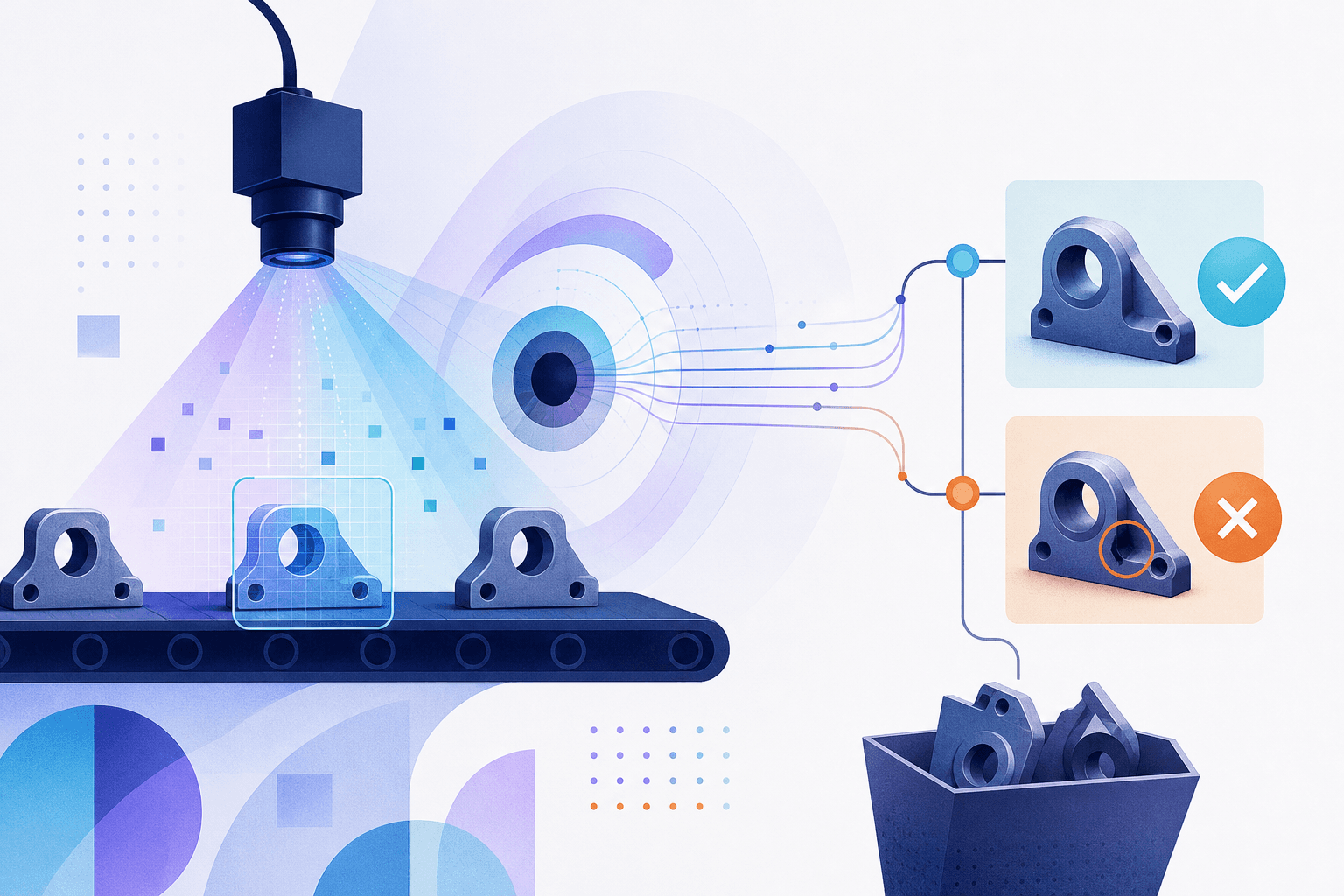
Computer vision—software that interprets images—has a credible quality-inspection business case when defects are visible, image capture is repeatable, and avoided inspection or defect costs exceed the full cost of operating the system. Start with one product family and one inspection station. If the proposal depends on perfect detection, eliminating all inspectors or discovering defects the camera cannot see, it is not ready for investment.
Establish what the camera can actually decide
Define the inspection decision before choosing a model: which defect, on which surface, at what minimum size, under which production conditions? A missing component and a shallow scratch may require different lighting, viewpoints and acceptance rules.
As a practical starting point, collect images across shifts, suppliers, product variants and normal equipment vibration. Ask quality specialists to label defects and resolve disagreements. If reviewers cannot consistently judge the same image, improve capture or clarify the specification before training.
Test whether simpler equipment solves the problem: a presence sensor, dimensional gauge or fixed image-processing rule may be sufficient. Hidden material weaknesses may require a different sensing method rather than a more capable image model.
Budget for lenses, lighting, fixtures, cleaning, calibration and installation downtime—not just software. These are recommendations for implementation planning; the supplied references cover agent architecture and language-model security, not industrial vision performance.
Calculate value after false alarms and residual defects
Compare the proposed workflow against measured current performance. Count labour savings only where staffing, overtime or productive capacity actually changes. Count avoided defect losses relative to current inspection, not against a fictional process that catches nothing.
Illustrative worked example—not an AIoverflow deployment: A station inspects 200,000 units monthly. Assume a pilot supports these estimates:
| Monthly item | Illustrative value |
|---|---|
| Redeployable inspection capacity | $6,000 |
| Avoided downstream defect losses versus current inspection | $5,000 |
| Software, compute and support | −$2,000 |
| Camera maintenance and calibration | −$500 |
| Exception review | −$1,500 |
| Additional handling of falsely flagged good units | −$1,000 |
| Net monthly benefit | $6,000 |
The review allowance assumes 6,000 cases monthly, taking 30 seconds each at $30 per hour: 50 hours, or $1,500. False-alarm handling covers additional costs beyond that review time, avoiding double counting.
With $72,000 in installation and integration costs, simple payback is 12 months, excluding financing, taxes and ramp-up. If redeployment cannot be realised, net benefit falls to zero. If review volume doubles, another $1,500 disappears monthly before additional handling costs.
This sensitivity matters more than an impressive demonstration. Finance and quality owners should agree on conservative defect-loss assumptions, including residual missed defects, before approving the project.
Keep the inspection loop simple and traceable
A recommended production sequence is: identify the item, capture images, check image quality, run the detector, apply an approved decision threshold, route the item and confirm the physical outcome. Record the item identifier, model version, result and routing acknowledgement.
A decision threshold is the score boundary used to flag a suspected defect; it is not proof that the score represents a calibrated probability. Tune it against the costs and consequences of both error types.
Do not add autonomous agents merely because the project uses AI. Microsoft’s agent architecture guidance explains that additional orchestration introduces latency, coordination costs and failure modes. Although written for language-model systems, it supports a useful design principle here: keep the time-critical inspection path bounded and predictable.
If a language model drafts defect reports from images or supplier notes, keep it outside equipment control. Prompt injection means untrusted content attempts to redirect a model’s behaviour. OWASP’s guidance includes image-borne instructions and recommends enforcing permissions outside the model. A reporting assistant should not gain authority to release held stock or change inspection limits.
Prove quality and recovery before automatic rejection
Run in shadow mode first: produce predictions without changing physical routing, then compare them with independently reviewed outcomes. Keep images of the same physical item out of both training and testing. Reserve later production batches to test whether performance carries forward.
Agree on concrete release criteria:
- Missed-defect rate: defective units incorrectly passed, divided by defective units tested, reported separately for each defect severity.
- False-alarm rate: good units incorrectly flagged, divided by good units tested, with review demand calculated at production volume.
- Timing: capture-to-routing completion before the item reaches the diversion point, including worst-case delays and timeout tests.
- Traceability: every tested item has one matched decision and confirmed routing outcome.
- Evidence strength: document sample counts and statistical uncertainty; zero misses in a small sample does not establish zero risk.
Include an explicit failure path. A blurred image, unknown product variant, disconnected camera or late result must never silently become a pass. Depending on the approved operating procedure, divert the item to a hold lane, restore manual inspection or stop the station. Test a full hold lane and failed rejection mechanism as well as model errors.
Assign ownership for cleaning, threshold changes, exception queues and rollback. Our guide to recoverable AI exception handling expands on these operational controls.
Fund automatic routing only when measured economics, defect-specific quality limits and physical recovery tests all pass. To scope that decision with clear acceptance criteria and integration responsibilities, contact AIoverflow.
Sources & further reading
Prepared with AI assistance using the sources above and AIoverflow’s service context. Examples are illustrative; validate implementation decisions against your own requirements. Suggest a correction.